




Since the current Israeli government took office in December 2022, the authorities have intensified their policies aimed at displacing Palestinians in parts of the occupied West Bank known as Area C which is under Israeli control. These efforts have surged following the Hamas-led attacks of 7 October 2023 and Israel’s genocide against Palestinians in the Gaza Strip.
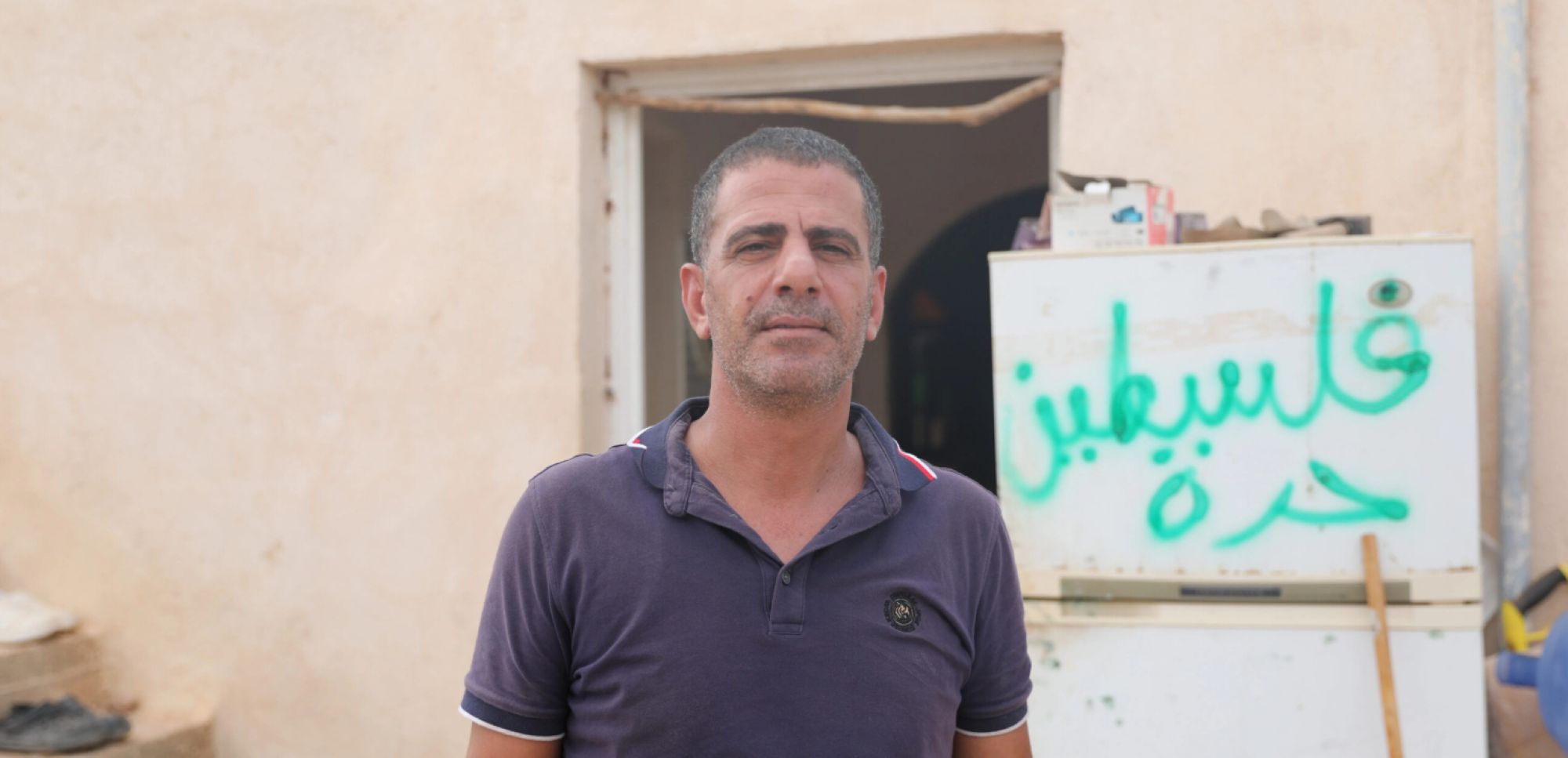
In the Northern Jordan Valley, these policies—coupled with escalating settler violence—have displaced dozens of Palestinian communities and threaten hundreds more. Here Palestinian farmer Rasheed Khudeiri, an activist with the Jordan Valley Solidarity Campaign, describes residents’ daily struggle to remain on their land, the impact on their family and livelihood, and their unwavering resilience in the face of systemic efforts to uproot them.
—
I have lived in Bardala since 1982. Bardala, like other nearby Palestinian communities, has always been a village with a strong community spirit. In 1965, after the Israeli water company Mekorot drilled several wells nearby across the line separating Israel from the Occupied Palestinian Territory. They drained the natural water springs we depended on, so local residents met and decided to dig an artesian well. The village could not afford to pay for workers, so everyone chipped in – some did the digging, others fed the workers or offered them a place to stay, and so on. It was a beautiful example of collective effort and the well revived our agriculture. However, in 1973, six years after the Israel occupied the territory, Mekorot took over the village’s well and made an agreement to sell water to the village residents while discounting the expenses of pumping the water.
Things changed further in 1993, when the water company dug three new wells inside Bardala but did not provide water to cover the village residents’ needs. As a farmers’ village, we find it hard to sustain our agriculture without access to water. Israel controls the water, supplying it to settlements abundantly, and preventing it from being supplied to Palestinian communities. Only last month, I lost 10,000 kilos of muloukhiyya (jute) crops. The water supply was cut off, and I couldn’t water my plants. Not only are our plants thirsty, so are we. It is a clear policy of discrimination.
Displacement of Palestinians in Area C
The Jordan Valley comprises almost 30% of the West Bank. About 90% of its lands were categorized as Area C of the West Bank under the Oslo Agreement. There are 37 Israeli settlements and dozens of settler outposts in this area. The outposts are not established by the state, but by settlers who take over the land and natural resources with impunity. Around 39% of the Jordan Valley lands are categorized by the Israeli authorities as natural reserves and military firing zones and are off limits for Palestinians. This further facilitates the seizure of natural resources, as well as the displacement of the indigenous Palestinian population. Palestinians who hold ownership deeds to lands in one of these categories are barred from accessing these areas while settlers move in and use the lands for cattle grazing.
The Israeli authorities have also granted sweeping powers to the settlement councils in the West Bank to take over land and water resources, empowering Israeli herding settler outposts. The phenomenon of herding settler outposts became prevalent in 20212, but things escalated dramatically in 2018–2019, when Israeli settler farming outposts started spreading across hilltops and mountain peaks.
After Prime Minister Benjamin Netanyahu and Finance Minister Bezalel Smotrich came to power in late December 2022early 2023, the Israeli government applied a series of policies with the goal of destroying Palestinians’ means to live on their land. It also dramatically increased its support to these settlements. These outposts have been a disaster for us. The settlers, including violent young groups of settlers called the “Hilltop Youth”, have created a climate of fear to intimidate Palestinians into leaving.
Encroachment of settler outposts
In the northern Jordan Valley area alone, settlers have taken over seven water springs that Palestinians depend on for livelihoods. Herding settlers don’t only steal our natural resources, they also appropriate our culture, heritage and lifestyle. Settlers in outposts herd cattle and sheep, build mud houses and make Palestinian dairy products.
There is a farming outpost just one mile to the north out of Bardala , in the area of Qa’oun, Tabayeq and Marah A-Tajat. The Israeli army set up a checkpoint near it. There is a whole chain of outposts surrounding the area, designed to work together to close off roads and prevent access to land and other resources which Palestinian communities depend on.
Israeli herding outposts might sit on small pieces of land of a few dunums each, but they take over huge areas of land for grazing. And on top of this, there is the violence. Not long ago, there was a settler attack on Hammamat al-Maleh. They stole a flock of 50 sheep in the middle of the night and tried to escape with them. But the sheep were afraid to enter unfamiliar areas, and the settlers slaughtered them—some with knives, some were shot dead. What can be said when even animals are targeted?
They’re taking control of our lifeline to Palestinian land
And now Israel wants to apply its laws to Palestinian lands. By what right? By what right do they confiscate my tractor? Or prevent me from accessing my water spring? Five natural springs have recently been taken over by settlers. They’re taking control of our lifeline.
I have fond memories of swimming at the Al-Malih hot water springs as a child with my family and visiting on school trips. The last time I swam there was in 1998 while on a picnic with my grandfather. I remember how my cousins and I put on our swimming shorts and jumped in the water. When it was time to go home, I didn’t want to come out of the water. They steal the land, the water, by force, and even our will to survive they try to kill it. But do you think they can ever truly understand this land and what it holds? Know it and own it the way we do? I say no.
A deep connection to the land
One day, while heading home, I was stopped at Hamra checkpoint. The soldiers asked for my ID and searched the car. I had five “dom” fruits with me—also known as “sidr” (Christ’s thorn jujube), a native tree found all over this area.
It has deep cultural roots for our communities: people sing about it, use its leaves for healing, and honey made from its flowers is considered the finest. The soldier asked what the fruits were, and I jokingly said: “apples from Europe”. He asked for one, and I refused. So, he detained me until I agreed to give him one. The irony? Just a few metres behind him stood a sidr tree full of fruit—and he didn’t even recognize it.
Despite all these hardships, we either die or live in one place—on our land. We don’t want to live away from it, and we don’t want to die away from it. That’s why the least we can do is protect ourselves and our neighbours.
Learn More
Take Amnesty International’s course to learn more about apartheid: What is apartheid?
For more information on the role of states and companies in halting the political economy enabling Israel’s genocide, apartheid and unlawful occupation see: Pull the plug on the political economy enabling Israel’s crimes