




Please join us on Human Rights Day, Wednesday December 10 at 9:30 PDT, 10:30 CST, 12:30 EDT,1:30 ADTfor the tenth and final webinar in our ongoing series on the abolition of the death penalty. This series is sponsored by Amnesty International Canada, Carleton University’s Youth & Justice Lab, The Human Rights Research and Education Centre at the University of Ottawa, The Canadian International Council (Saskatchewan Branch), The Mardom Foundation, The Paivand Society and the campaign United Against Executions in Iran.
The abolition of the death penalty requires, among other things, a human capacity for forgiveness for the people who have suffered from the sanction in various ways. The trauma that capital punishment inflicts on individuals and society as a whole must be acknowledged, addressed, and in time, healed in order to plant the seeds of nonviolence in diverse communities. Further, clemency plays an unquestionable role in the path towards the abolition of the death penalty. This session explores the theme of forgiveness and nonviolence concluding the series in 2025.
.
Our Webinar Panelists and Moderator
Arzoo Osnloo is a Professor at the University of Washington’s Department of Law, Societies, and Justice, and Director of its Title VI Middle East Center. She holds adjunct appointments in the School of Law and Departments of Anthropology, Near Eastern Languages and Civilization, Women’s Studies, and the Comparative Religion Program. She received her PhD in Cultural Anthropology at Stanford University in 2002. Prior to that, she was a practicing attorney, having received a JD at The American University, Washington College of Law in 1993. She turned to the discipline of Cultural and Social Anthropology in order to better promote and advocate for the humanity and dignity of people in other societies – societies which are simultaneously entrenched in domestic and international politics and law, historical relations, and are constantly changing.
Bahar Saba is the senior researcher on Iran and Kuwait at Human Rights Watch. For over a decade, she has been carrying out investigation, documentation, and advocacy work in connection with the human rights situation in the Middle East and North Africa, with a primary focus on Iran.
Prior to joining Human Rights Watch, Bahar worked at several international human rights organisations, including Amnesty International, Reprieve and ARTICLE 19, where she investigated a wide range of human rights issues such as the death penalty, arbitrary detentions, torture and ill-treatment, unlawful use of force, discrimination on various grounds and accountability, and authored numerous research reports and advocacy briefings. She has also worked as an investigator with a UN established investigative body.
Bahar has a law degree from the University of Tehran, an L.L.M in human rights law from the University of Nottingham, and an M.Phil in Modern Middle Eastern Studies from the University of Oxford. She is fluent in Persian and English and has an advanced knowledge of Arabic.
Roya Boroumand is the Co-Founder and Executive Director of the Abdorrahman Boroumand Center for Human Rights in Iran. A historian with a Ph.D. in the history of international relations and contemporary IRAN, she previously worked with the Women’s Rights Division of Human Rights Watch, where she focused on discrimination and violence against women in North Africa. Since 2001, Dr. Boroumand has led the Boroumand Center’s research and advocacy on Iran’s human rights record and transnational repression, authoring and editing reports and newsletters on terrorism, crimes against humanity, extrajudicial executions, and Iran’s abuse of the death penalty, elections, COVID 19 in Iran’s prisons. She has also directed human rights advocacy before the United Nations and the European Union and organized campaigns for legal reform and the release of political prisoners and a traveling exhibit on the persecution of students. She is a member of the Steering Committee of Impact Iran. She and the organization’s co-founder, Ladan Boroumand, received the 2009 Lech Wałęsa Prize, and in 2024, she was awarded the Goler T. Butcher Medal of the American Society of International Law in recognition of her dedication to rigorous and objective documentation and commitment to promoting human rights and democracy in Iran.
Omid B. Milani, Ph.D., is a scholar of human rights law and a multimedia artist, interested in interdisciplinary and transformative approaches to the current discourse on human rights. His research interests include a wide range of subjects, e.g. law and aesthetics, domestic and state-sponsored violence, constitutional rights and freedoms, political philosophy, and sociolegal studies of human rights. He is well-versed in diverse legal systems and traditions including International Human Rights Law, Civil/Common Law, Islamic Jurisprudence (Shia Sharia Law), and Customary Law.
His current research focuses on the following themes, namely, friendship as law (critiquing hierarchy in law), current instances and origins of the use of force by the state (e.g. in the Middle East), as well as diversifying the means of expressions in legal scholarship. Throughout his academic career, art has been an inseparable component of his research and teaching. Images of Justice, a yearly satirical cartoon series, which he curated in partnership with the HRREC, is an illustration of his unique way of juxtaposing research findings with artistic expressions to shed light on our ongoing conversations in the field of human rights.
Our moderator Samira Mohyeddin has a Master of Arts in Modern Middle Eastern History and Gender from the University of Toronto and Genocide Studies from the Zoryan Institute. She is the inaugural 2024 / 2025 Journalism Fellow at the University of Toronto’s Women and Gender Studies Institute. Samira is an award-winning journalist and producer. For nearly ten years she was a producer and host at CBC Radio and CBC Podcasts. She resigned in November of 2023 and founded ‘On The Line Media’.
Background on the 2025 webinar series on the abolition of the death penalty
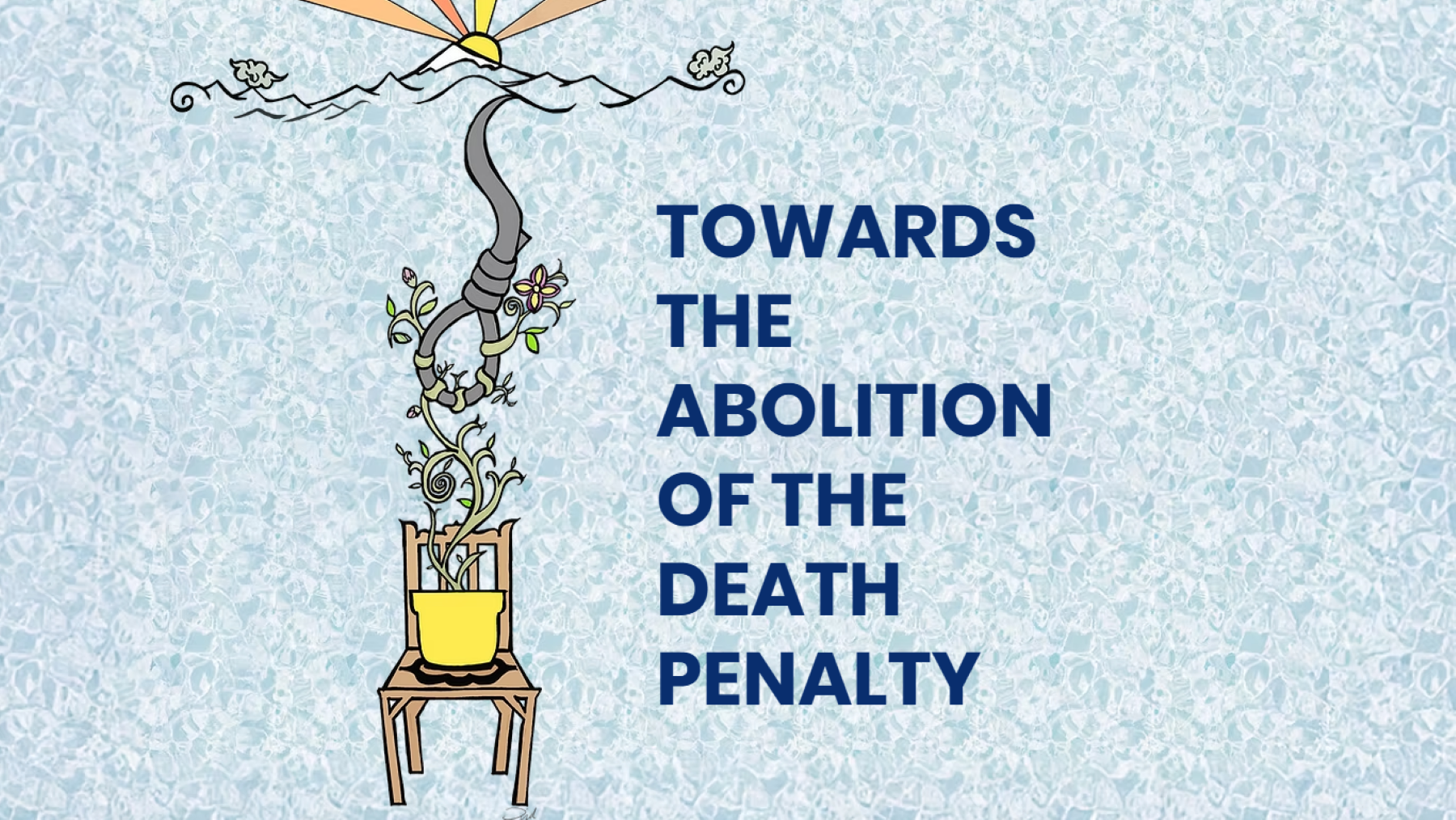
Towards the Abolition of the Death Penalty is a virtual panel discussion series that will tackle the complex question of the death penalty with a view to its abolition in retentionist states, particularly in the contemporary context of the Middle East, in Iran, Saudi Arabia, Afghanistan, Egypt, Syria, and Iraq. The panel series will provide in-depth discussions on the death penalty from diverse legal, philosophical, sociological, psychological, and political perspectives. The speakers will address and put in context current instances of the death penalty, exploring the dynamics involved in this criminal sanction. The series aims to create a dialogical platform for everyone interested in engaging with the abolitionist discourse to discuss the possibilities and challenges to put an end to the death penalty. Each session will introduce the audience to significant aspects of capital punishment, expounding theoretical and practical particularities of the sanction.
Poster & Artwork Design © Omid Milani