






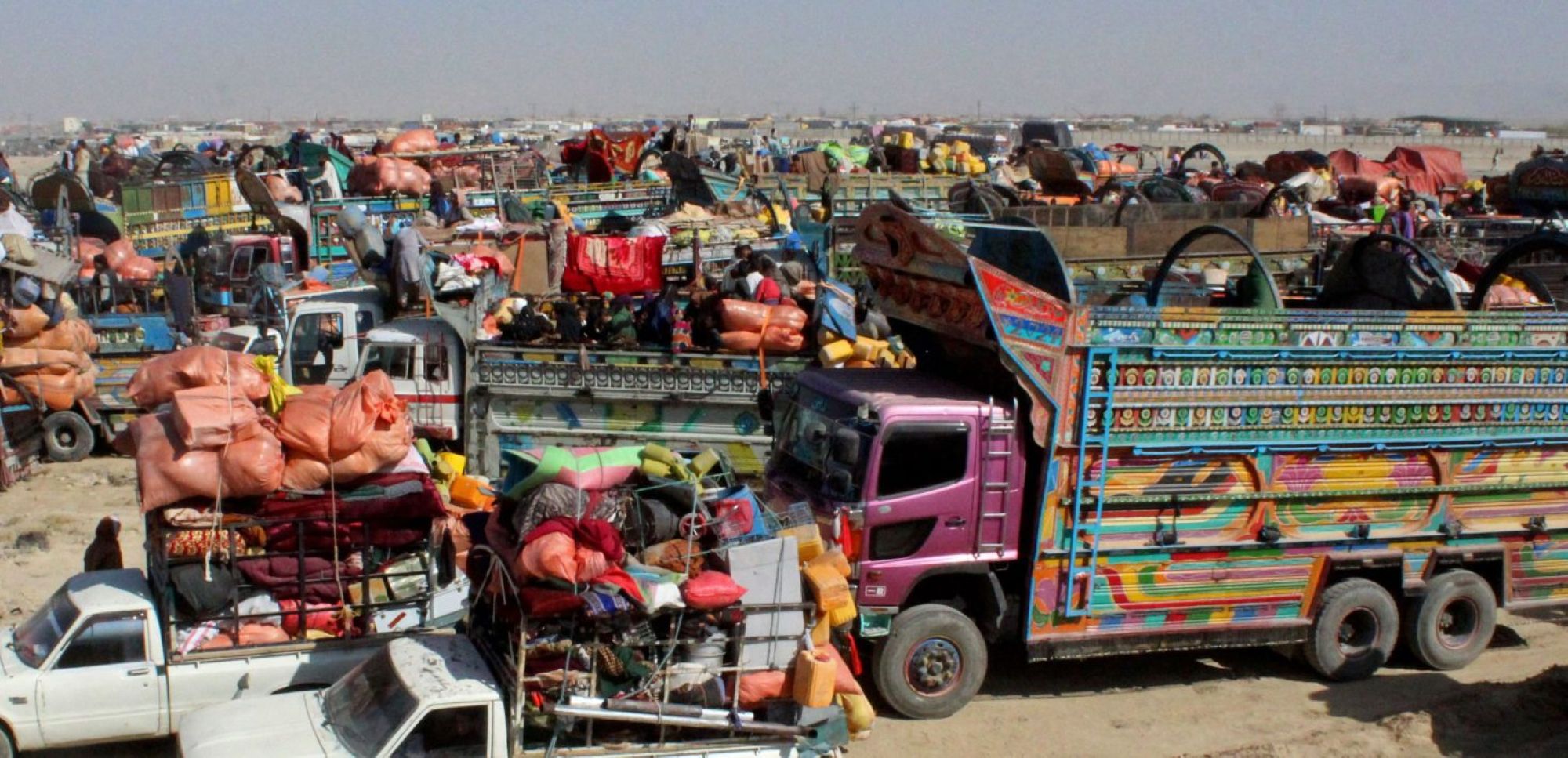
All forced returns of refugees and asylum seekers to Afghanistan must immediately end, Amnesty International said, as the latest UN figures revealed that Iran and Pakistan alone have unlawfully expelled more than 2.6 million people to the country this year. About 60% of those returned are women and children. Thousands of others have been deported from Turkey and Tajikistan.
The figures come as the Taliban intensify their attacks on human rights with devastating effect particularly on women and girls, and the country remains in the grip of a humanitarian crisis, which has been further exacerbated by the recent series of natural disasters. Afghanistan’s deepening humanitarian crisis increases the real risk of serious harm for returnees and underscores states’ binding non-refoulement obligations under customary international law, which prohibits the forcible return of anyone to a place where they face a real risk of grave human rights violations.
This year, European states have also ramped up efforts to forcibly return Afghans, with media reporting Germany, Austria, and the European Union in negotiations with the de facto Taliban authorities to facilitate forced returns.
“Despite the Taliban’s well-documented repression of human rights, many states, including Iran, Pakistan, Turkey, Tajikistan Germany and Austria, are clamouring to deport Afghans to a country where violations particularly against women, girls and dissenting voices are widespread and systematic. This is without even mentioning the dire and deepening humanitarian crises, with more than 22 million people – nearly half of the country’s population – in need of assistance,” said Smriti Singh, Amnesty International’s Regional Director for South Asia.
“This rush to forcibly return people to Afghanistan ignores why they fled in the first place and the serious dangers they face if sent back. It shows a clear disregard for states’ international obligations and violates the binding principle of non-refoulement.”
Under the Taliban, women and girls are being systematically erased from public life. They are banned from education beyond the age of 12, their freedom of movement and expression are denied, and they are prohibited from working with the UN, NGOs, or in state affairs – except in exceptional cases such as airport security, primary education, and healthcare. Those who worked for the former government – specifically members of the Afghanistan National Defence and Security Forces (ANDSF) – or those criticizing the Taliban’s draconian policies, including human rights defenders and journalists, also face continued severe reprisals.
Amnesty International conducted 11 remote interviews: seven with those who were forced to return to Afghanistan from Iran and Pakistan, and four with Afghan refugees and asylum seekers who were at risk of immediate deportation from Iran and Pakistan, between July and November 2025. One of the four interviewed, fearing arrest by the Taliban, managed to return to the country from which she had been deported.
Attacks against former Afghan government employees
Following recent cross border clashes with the Taliban, Pakistan has intensified its efforts to deport Afghan refugees. Meanwhile, in Iran, at least 2.6 million Afghans were registered in 2022 for temporary protection and access basic services, including public education, work authorization and state healthcare, via a “headcount” document. However, on 12 March 2025 Iran’s Centre for Foreign Nationals and Immigration Affairs, which falls under the Ministry of Interior, announced that “headcount” documents for Afghans would automatically expire from the start of the year 1404 on Iran’s calendar (corresponding to 21 March 2025), and that access to socioeconomic services would be terminated.
The Iranian authorities’ mass expulsions scaled up in the aftermath of the escalation of hostilities between Israel and Iran in June 2025, and between July and October 2025, over 900,000 Afghans were unlawfully expelled from Iran, out of 1.6 million between January and October 2025.
Shukufa* worked with the former Afghan government and at an international organization prior to the Taliban takeover in August 2021. She fled to Iran in early 2022, but was forcibly returned a few months later after her visa expired. Immediately after returning, she fled to Pakistan where she managed to register for asylum with the UN Refugee Agency (UNHCR). But in June 2025, the police raided her house, and she was deported to Afghanistan along with her family members.
She described the situation under the Taliban: “We cannot freely leave our home… there are no job opportunities. Girls’ schools are closed. There are no employment opportunities. We [as former government officials and activists] cannot directly go to the Taliban-run offices for fear of being recognized.”
Several former government officials, members of the former security forces, and activists who spoke to Amnesty International said that they live in fear and could not return to their provinces or previous residences due to their past work and activism. Despite announcing a general amnesty for those who worked under the former government, the Taliban have persistently targeted former government officials and members of security and defence forces with arbitrary arrests, torture, unlawful detention, and extrajudicial killings.
These abuses have continued, including against individuals who have been forcibly returned. The UN Assistance Mission in Afghanistan (UNAMA) documented 21 instances of arbitrary arrest, torture, and ill-treatment, along with the killings of 14 former members of the security and defence personnel between July and September 2025 alone. On 21 November, an Afghan media outlet operating from abroad reported that Taliban had arrested five former security personnel who had been deported from Iran and were on their way to their home province, Panjshir.
Shukufa*, who worked with the previous government, said: “I cannot go the place where I previously lived. Someone else is staying in the house. We have rented a house in a different location… My husband worked in the security agencies. He is also afraid for his security.”
Gull Agha*, who worked in the security and defence agencies prior to August 2021, was forced to return from Iran in April 2025 after his “headcount” document was declared expired. He said the Iranian officials had claimed that he and other Afghan nationals could re-enter Iran by applying for work visas at the Iranian consulate and embassy in Afghanistan without acknowledging the grave risks Gull Agha and others like him would face if returned to Afghanistan.
He said: “Though we were told that (in Afghanistan) we can refer [ourselves] to the Iranian Consulate for a work visa, since I am a former security personnel, I cannot go and apply for a [Afghan] passport at the passport department. It has all my biometric data.”
He also said those who had approached the Iranian consulate were told no such ‘work visa’ programme existed.
In August 2025, a survey by UNHCR reported that 82% of the returnees were in debt due to displacement, a lack of jobs, and loans taken to meet basic needs upon arrival in Afghanistan.
Persecution of women and girls
Despite facing some of the worst gender-based discrimination in the world – amounting to the crime against humanity of gender persecution – women and girls are being deported to Afghanistan in large numbers. According to UN estimates, half of those deported from Pakistan were women and girls, while 30% of deportees from Iran up to June 2025 were women and girls.
Women’s rights activist Sakina* fled to Pakistan after the Taliban takeover in 2021 but was forcibly returned in September 2025, despite being registered with UNHCR and being listed on a US humanitarian resettlement programme.
The Taliban twice arrested and beat members of Sakina’s family to reveal her whereabouts. Upon her return to Afghanistan, she moved to a different province before escaping the country again.
“I did not leave the house during my stay in Afghanistan. Women are afraid of the Taliban. I felt [hope] had died in people because of the fear from the Taliban. I was not only afraid that the Taliban would recognize me, but also, I was afraid that the Taliban would arrest me for not wearing hijab,” Sakina told Amnesty International.
“All states must immediately stop forced returns and uphold their non-refoulement obligations under international law. Failing to do so means ignoring the grave dangers Afghans face and turning away from their legal and moral responsibilities. States must also widen and fast-track resettlement routes and recognize Afghan human rights defenders, women and girls, former officials, journalists, and others at increased risk, as prima facie refugees,” said Smriti Singh.
*Names changed to protect identities
What you can do to help
The international community cannot continue to take a ‘business as usual’ approach to the human rights situation in Afghanistan. Join Amnesty’s urgent call to end the cycle of violence.